Author: Xander Blaauw

  • MCP: The Protocol Powering the AI Agents Revolution

    By Xander Blaauw
    AI Agent Architect & Infrastructure Specialist at pAinapple. Xander designs and deploys autonomous AI agents in production environments across Dutch enterprises. 5+ years in AI automation and infrastructure design.

    Meet Spoor, a hands-on software engineering assistant that leverages the Model Context Protocol (MCP) to automate and streamline infrastructure management on the pAinapple platform.

    But here’s what you should really know: Spoor isn’t special because of how smart it is. It’s special because of what it’s connected to.

    The Pattern You’re Seeing

    If you read our post today on The AI Agents Revolution, you saw something critical: the real transformation isn’t about smarter AI models. It’s about AI that can actually do things—manage workflows, control systems, connect to tools, and operate autonomously across your infrastructure.

    That capability doesn’t exist in a vacuum. It requires a standard.

    Enter MCP: The “USB-C for AI”

    The Model Context Protocol (MCP) is emerging as the foundational standard for connecting AI agents to the tools, systems, and data they need to act. Think of it as USB-C for AI—one plug-and-play protocol that lets any AI model talk to any tool, service, or database in a secure, standardized way.

    MCP was introduced in late 2024 by Anthropic and has since been adopted by OpenAI, Google, and Meta. By early 2026, industry estimates suggest that 90% of organizations will be using MCP-compatible infrastructure by year-end. That’s not a niche standard. That’s the future of enterprise AI.

    What Spoor Does (and Why It Matters for You)

    Spoor is a practical example of MCP in action. Here’s what it can actually do:

    • Full terminal access and process management via the Desktop Commander MCP server—run commands, manage containers, spawn processes, and monitor systems
    • File system operations with surgical precision—read, write, search, edit files without human hand-holding
    • Docker orchestration—build, deploy, debug containers in your infrastructure
    • Python project scaffolding with the modern uv package manager—reproducible, deterministic builds
    • Web search and information retrieval via the Gateway MCP server—research, context gathering, real-time data
    • Persistent memory—a knowledge graph that remembers decisions, preferences, and context across sessions

    None of this is magic. It all flows through MCP, which standardizes how Spoor connects to each system. Add a new tool? Write one MCP interface. Connect to a new service? One standard protocol.

    Why This Matters for SMEs and Enterprises

    Most organizations today are still asking: “Should we adopt AI agents?” Wrong question. The question that matters is: “How quickly can we make our systems agent-ready?”

    The companies moving fast aren’t waiting for perfect AI. They’re standardizing on MCP, exposing their APIs and data through MCP interfaces, and letting autonomous agents operate in their infrastructure with proper governance. The barrier to competitive advantage has shifted from “Do we have AI?” to “Can our AI actually talk to our systems?”

    If your infrastructure isn’t MCP-ready, you’re already behind.

    What’s Coming

    We’re posting daily on AI agents, autonomous systems, and the tools reshaping how infrastructure works. Most of it will be spotlights on interesting tools and frameworks you can actually use. Once a week or so, we’ll zoom out and look at the bigger pattern—like we did today. Every month, we’ll do a deeper review.

    If you’re managing infrastructure for SMEs or enterprises, this is the moment to understand what’s coming. The companies that move fast on this will have a genuine competitive edge.

    If you’re curious about how this actually works in practice—or want to talk about building AI-ready infrastructure for your organization—drop us a message on the contact page. No pitch. Just conversation about what’s actually possible.

  • The AI Agents Revolution: From ChatGPT to Autonomous Workers

    By Xander Blaauw
    AI Agent Architect at pAinapple. Xander builds production AI agents for Dutch enterprises. Specializes in agent architecture, workflow automation, and enterprise infrastructure design. 5+ years in AI automation.

    Something seismic just happened in AI, and most people missed it.

    While everyone was debating whether AI would replace jobs, a quiet shift in the technology itself has already begun reshaping how work actually gets done. The story isn’t about smarter models anymore—it’s about AI that does things.

    From Chatbots to Autonomous Agents

    For years, AI assistants have been passive. You ask a question, they give you an answer. That era is ending.

    In late 2025, a developer named Peter Steinberger created an experiment called OpenClaw—a self-hosted agent framework that anyone could run on their Mac Mini. Instead of answering questions, OpenClaw’s agents take actions: managing emails, controlling your web browser, executing code, orchestrating workflows across apps. By early 2026, it had exploded to over 190,000 GitHub stars, making it one of the fastest-growing open-source projects ever.

    Why? Because it proved something fundamental: with the right orchestration, off-the-shelf AI models could handle complex, multi-step tasks with minimal human intervention. The barrier to autonomous AI had collapsed to near zero.

    The Race Is On—And It’s Moving Fast

    OpenClaw lit a fuse. Within weeks, every major AI player launched their own vision:

    • Perplexity Computer (Feb 2026) launched as a “massively multimodel” system orchestrating 19 different AI models. Define a high-level objective—”launch a marketing campaign” or “build an app”—and Computer decomposes it into subtasks and executes them. One analyst called it “the most complete AI agent system available right now.”
    • ChatGPT Agent evolved from a standalone product into an embedded agentic mode within ChatGPT itself, capable of browsing the web, performing tasks, and chaining actions autonomously.
    • Claude Dispatch (Anthropic, March 2026) lets users ask Claude via smartphone to perform tasks on a linked computer—and come back later to find the work finished. A driver stuck in traffic asked Claude to export a presentation as PDF and email it; Claude completed the job remotely on his home computer.
    • Meta’s Manus Agents live in Telegram (with WhatsApp, Slack, and Discord coming soon), performing everything from apartment hunting to website building.

    The enterprise signal is unmistakable: if a single developer with a Mac Mini can deploy autonomous agents managing workflows across dozens of systems, the barrier has collapsed. Companies still debating pilot programs are competing against ecosystems where individuals can deploy them in hours.

    The Agentic Web: When Browsers Become Agents

    There’s a second shift happening in parallel. In January 2026, Google launched Chrome Auto Browse—a feature that turns your browser into an autonomous agent. Tell Gemini 3 to “Find and book a hotel in London with late checkout and send me a confirmation,” and the browser proceeds to click, scroll, fill forms, and navigate pages without further input.

    This isn’t an isolated feature. It’s the emergence of the “agentic web”—the shift from humans browsing the internet to AI agents acting on the internet on our behalf.

    The implications are profound:

    • SEO is dying. AI shopping assistants don’t care about flashy design or emotional branding. They optimize for clear data and structured information. “Agent Experience Optimization” (GEO) is replacing traditional SEO.
    • An agent-to-agent economy is emerging. Your customer’s personal AI agent negotiates pricing with your company’s sales AI. Your procurement AI queries supplier agents for inventory and places orders. Google’s Agent2Agent Protocol (launched April 2025) is laying the groundwork for these machine-speed interactions.
    • Your IT architecture must become agent-ready. APIs, data repositories, and business systems need to be designed so AI agents can safely interact with them. Anthropic’s Model Context Protocol (MCP) has become the de facto standard—think of it as “USB-C for AI.”

    The Productivity Paradox Nobody Talks About

    Here’s the uncomfortable truth: developers feel faster with AI. Studies show they’re actually slower.

    A 2025 METR study tracked 16 experienced open-source developers completing real tasks. Those using AI tools took 19% longer. Yet afterward, participants still believed AI had sped them up.

    The reason? Amdahl’s Law. Even if code generation is instant, the system can’t move faster than its slowest part: review, testing, deployment. When AI generates code at superhuman speed, review times increase 91%, pull requests grow 154% larger, and teams merge 98% more pull requests. Individual gains are absorbed entirely by downstream friction.

    Task-level productivity is up. System-level productivity is flat or down.

    The winners won’t be those who just handed developers AI tools. They’ll be those who redesigned their entire workflow around AI capabilities.

    The Human Cost: AI Fatigue Is Real

    There’s another side effect nobody predicted: exhaustion.

    A UC Berkeley field study (published in Harvard Business Review, Feb 2026) watched what happened when workers enthusiastically adopted generative AI at a 200-person tech company. Initially, fear of job loss vanished. But output increased—so expectations increased. What used to be 80% low-intensity work flipped to 80% high-intensity work. Employees worked faster, accomplished more, but also worked into nights and weekends.

    37% of workers now report “AI fatigue.” One-third say their workload increased after AI was introduced.

    As one engineer put it: “You think you’ll save time and work less. But you don’t. You just work the same amount—or more.”

    What’s Actually Changing

    Strip away the hype, and here’s what’s really happening:

    1. Agents are the new operating model. Tasks that took days now take hours. This isn’t a 10% efficiency gain—it’s a fundamental shift in how work flows through organizations.
    2. The integration layer is critical. Success isn’t about the AI model. It’s about whether your systems can talk to the AI. Standards like MCP and A2A are more important than any single model.
    3. Workflow redesign is mandatory, not optional. You can’t just plug in AI and hope productivity goes up. You have to rebuild how work happens.
    4. Human factors matter more than tech specs. Burnout kills productivity faster than any technical limitation. Organizations ignoring AI fatigue will lose talent faster than they gain speed.

    The Moment We’re In

    We’re at the inflection point where AI goes from “assistant” to “autonomous worker.” The technology is ready. The tooling is standardizing. The competitive pressure is intense.

    Companies that treat this as a tooling decision will fall behind those treating it as an operating model transformation. The gap between leaders and laggards will widen dramatically in 2026.

    The question for your organization isn’t “Should we adopt AI agents?” It’s “How quickly can we redesign for them?”

  • MCP (Model Context Protocol) in het MKB: Praktische Toepassingen en Privacy-uitdagingen in 2026

    By Xander Blaauw
    AI Automation Specialist at pAinapple. Xander architets MCP implementations and AI workflow automation for Dutch enterprises. Focuses on practical privacy-compliant AI integration. 5+ years in AI automation and compliance.

    Original content: MCP in het MKB artikel…

  • AI Act 2026: Een Praktische Gids voor MKB-bedrijven in Nederland

    By Julius Bergkamp
    AI Compliance & Security Specialist at pAinapple. Julius specializes in EU AI Act compliance, data privacy in AI systems, and building privacy-first AI infrastructure. 5+ years in privacy law and AI governance.

  • OpenClaw: Een Cybersecurity Nachtmerrie of de Toekomst van AI Automatisering?

    Door: pAinapple’s Automation Team

    Inleiding

    ClawD.bot, recent hernoemd naar Moltbot, is een open-source, zelf-gehoste AI-assistent die de tech-wereld stormenderhand verovert. Ontwikkeld door de Oostenrijkse softwareontwikkelaar Peter Steinberger, belooft ClawD.bot gebruikers een persoonlijke AI-assistent die lokaal draait op hun eigen hardware. Het klinkt als een droom voor privacy-bewuste gebruikers, maar is het ook een cybersecurity nachtmerrie? In deze blogpost duiken we in de werking van ClawD.bot, de beveiligingsrisico’s, en hoe je deze tool veilig kunt inzetten.

    Wat is ClawD.bot?

    ClawD.bot is een zelf-gehoste AI-assistent die gebruikmaakt van berichtenapps zoals WhatsApp, Telegram, Discord, en Slack om met gebruikers te communiceren. In tegenstelling tot cloud-gebaseerde AI-assistenten zoals ChatGPT of Google Gemini, draait ClawD.bot volledig lokaal op je eigen computer, server of zelfs een Raspberry Pi. Dit betekent dat je data op je eigen machine blijft, wat privacyvoordelen biedt. Daarnaast kan ClawD.bot integreren met externe tools en systemen, zoals e-mail, CRM-systemen, en slimme huisapparaten, via het Model Context Protocol (MCP). Dit protocol stelt AI-modellen in staat om te communiceren met externe databronnen en tools.

    Hoe werkt ClawD.bot?

    ClawD.bot bestaat uit drie hoofdcomponenten:

    1. Gateway: Dit is het hart van ClawD.bot. Het beheert verbindingen met berichtenplatforms, sessies, tool-integraties, en geautomatiseerde taken. De Gateway draait als een achtergrondproces en is bereikbaar via een lokale poort.
    2. AI-model: ClawD.bot ondersteunt verschillende AI-modellen, waaronder Anthropic’s Claude, OpenAI’s GPT-modellen, en Google’s Gemini. Gebruikers kunnen zelf kiezen welk model ze willen gebruiken.
    3. MCP-servers: Deze servers stellen ClawD.bot in staat om te communiceren met externe tools en services, zoals e-mail, CRM-systemen, en cloudservices.

    ClawD.bot maakt gebruik van Markdown-bestanden om zijn configuratie en geheugen te beheren. Dit betekent dat gebruikers volledig transparantie hebben over hoe de AI werkt en wat er onder de motorkap gebeurt.

    De Voordelen van ClawD.bot

    1. Privacy en Lokale Controle

    Een van de grootste voordelen van ClawD.bot is dat het lokaal draait. Dit betekent dat je gegevens niet worden opgeslagen in de cloud, maar op je eigen machine blijven. Dit is een groot voordeel voor gebruikers die zich zorgen maken over privacy en datalekken.

    “ClawD.bot is als een USB-C voor AI: een universele connector die elke AI in staat stelt om met elke tool te communiceren via één gestandaardiseerde interface.” — So-MC AI-Wiki

    2. Flexibiliteit en Aanpasbaarheid

    ClawD.bot is open-source en volledig aanpasbaar. Gebruikers kunnen de systeemprompt openen, bekijken wat er gebeurt, en alles naar wens aanpassen. Dit maakt het mogelijk om ClawD.bot precies af te stemmen op je eigen behoeften.

    3. Integratie met Bestaande Tools

    Dankzij MCP kan ClawD.bot integreren met een breed scala aan tools en services, zoals e-mail, CRM-systemen, en slimme huisapparaten. Dit maakt het mogelijk om ClawD.bot in te zetten voor een breed scala aan taken, van het beheren van je agenda tot het automatiseren van bedrijfsprocessen.

    De Beveiligingsrisico’s van ClawD.bot

    Hoewel ClawD.bot veel belooft, brengt het ook ernstige beveiligingsrisico’s met zich mee. Volgens Trending Topics, hebben cybersecurity-experts kwetsbaarheden geïdentificeerd die gevoelige gebruikersgegevens en toegangscodes in gevaar kunnen brengen.

    1. Blootstelling van API-sleutels en Privégegevens

    Een van de grootste risico’s is de blootstelling van API-sleutels en privégegevens. Volgens SlowMist, een blockchain-beveiligingsbedrijf, zijn er honderden onbeveiligde ClawD.bot-instanties toegankelijk via het internet. Deze instanties geven toegang tot complete configuratiegegevens, waaronder API-sleutels, bot-tokens, OAuth-geheimen, en handtekeningsleutels, evenals complete gespreksgeschiedenissen.

    “Honderden gebruikers draaien hun ClawD.bot-controleservers onbeveiligd op het internet, wat leidt tot blootstelling van gevoelige gegevens.” — Trending Topics

    2. Prompt Injection en Kwaadwillende Aanvallen

    Een ander risico is prompt injection, waarbij kwaadwillenden proberen om ClawD.bot te manipuleren via berichten. Dit kan leiden tot ongeautoriseerde toegang tot je systeem of het uitvoeren van schadelijke commando’s. Volgens FenIT, is het belangrijk om ACIP (Advanced Cognitive Inoculation Prompt) te implementeren om deze aanvallen te voorkomen.

    3. Gebrek aan Standaardbeveiliging

    ClawD.bot heeft geen standaardbeveiligingsmaatregelen die gebruikers beschermen tegen onbevoegde toegang. Dit betekent dat gebruikers zelf verantwoordelijk zijn voor het implementeren van beveiligingsmaatregelen, zoals IP-whitelisting en het configureren van reverse proxies.

    Hoe ClawD.bot Veilig te Gebruiken

    Gelukkig zijn er manieren om ClawD.bot veilig te gebruiken. Hier zijn enkele praktische tips om de risico’s te minimaliseren:

    1. Isoleer ClawD.bot op een Afzonderlijke Machine

    Een van de beste manieren om de risico’s van ClawD.bot te minimaliseren, is door het te draaien op een afzonderlijke machine, zoals een Raspberry Pi of een oude laptop. Deze machine moet niet verbonden zijn met je hoofdnetwerk en moet alleen toegang hebben tot het internet via een beveiligde verbinding.

    2. Gebruik een Firewall en IP-Whitelisting

    Implementeer een firewall en gebruik IP-whitelisting om alleen vertrouwde IP-adressen toegang te geven tot de ClawD.bot-Gateway. Dit voorkomt dat onbevoegde gebruikers toegang krijgen tot je systeem.

    3. Configureer een Reverse Proxy

    Gebruik een reverse proxy, zoals Nginx of Caddy, om de verbindingen naar ClawD.bot te beheren. Zorg ervoor dat de proxy correct is geconfigureerd om alleen vertrouwde verbindingen door te laten.

    4. Implementeer MCP met Beperkte Toegang

    Gebruik MCP om ClawD.bot te verbinden met externe tools, maar zorg ervoor dat je alleen toegang verstrekt aan vertrouwde bronnen. Beperk de toegang tot gevoelige gegevens en zorg ervoor dat je expliciete toestemming vereist voor tool-aanroepen.

    5. Monitor en Update Regelmatig

    Houd ClawD.bot en alle bijbehorende software up-to-date met de nieuwste beveiligingspatches. Monitor regelmatig wat ClawD.bot doet in je omgeving en controleer op verdachte activiteiten.

    MCP: De Sleutel tot Veilige AI-Integratie

    Het Model Context Protocol (MCP) speelt een cruciale rol in de werking van ClawD.bot. MCP is een open standaard die AI-modellen in staat stelt om te communiceren met externe tools en services. Het is ontwikkeld door Anthropic en wordt nu beheerd door de Agentic AI Foundation onder de Linux Foundation.

    Wat is MCP?

    MCP is een universele connector die AI-modellen in staat stelt om te communiceren met externe tools en services via een gestandaardiseerde interface. Het is vergelijkbaar met USB-C, maar dan voor AI. MCP maakt het mogelijk om AI-modellen te verbinden met een breed scala aan tools, zoals e-mail, CRM-systemen, en cloudservices, zonder dat er voor elke tool een aparte integratie nodig is.

    Voordelen van MCP

    • Open standaard: MCP is een open standaard, wat betekent dat het niet afhankelijk is van een enkele leverancier.
    • Model-agnostisch: MCP werkt met verschillende AI-modellen, waaronder Claude, GPT, en Gemini.
    • Bidirectionele communicatie: MCP maakt het mogelijk voor tools om ook requests te sturen naar de AI, wat de flexibiliteit vergroot.

    MCP en Beveiliging

    Hoewel MCP veel voordelen biedt, brengt het ook beveiligingsrisico’s met zich mee. Volgens Trending Topics, kunnen onbeveiligde MCP-servers leiden tot gegevenslekken en onbevoegde toegang. Het is daarom belangrijk om MCP-servers alleen te gebruiken van vertrouwde bronnen en om expliciete toestemming te vereisen voor tool-aanroepen.

    Conclusie

    ClawD.bot is een krachtige tool die veel belooft op het gebied van AI-automatisering en privacy. Het biedt gebruikers de mogelijkheid om een persoonlijke AI-assistent te hebben die lokaal draait en volledig aanpasbaar is. Echter, het brengt ook ernstige beveiligingsrisico’s met zich mee, zoals blootstelling van gevoelige gegevens en prompt injection-aanvallen.

    Om ClawD.bot veilig te gebruiken, is het belangrijk om beveiligingsmaatregelen te implementeren, zoals het isoleren van ClawD.bot op een afzonderlijke machine, het gebruik van een firewall en IP-whitelisting, en het correct configureren van MCP.

    Ons advies: Begin klein, experimenteer met ClawD.bot in een gecontroleerde omgeving, en zorg ervoor dat je de nodige beveiligingsmaatregelen implementeert voordat je het in productie neemt.

    Bronnen

  • Workshop AI Geletterdheid: Mous Waterbeheer

    Workshop AI Geletterdheid: Mous Waterbeheer


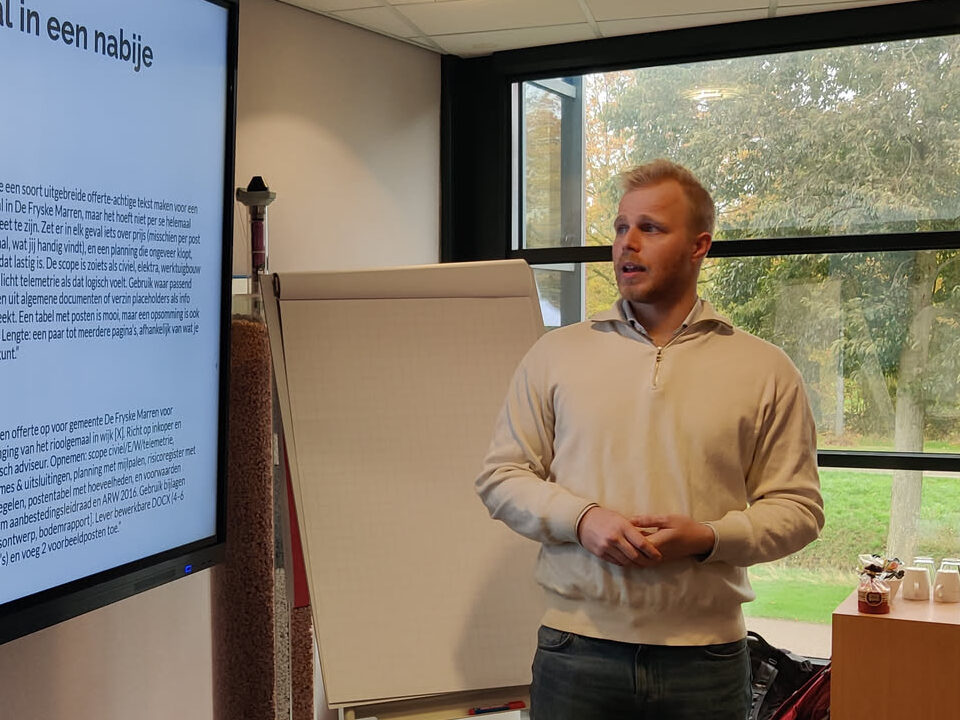
    Op 3 November 2025 stappen wij (Xander & Emile) s’ ochtends vroeg in de auto om naar het mooie Friesland af te reizen. Wij hebben daar met Emma van Trendshift afgesproken om voor Mous Waterbeheer een AI geletterdheid workshop te geven.

    Op ons wacht direct de eerste groep, deze bevat onder andere de algemeen directeur: Hidde Kriele. Leuk! Wij hebben ons goed voor bereid en zijn ruim op tijd.

    Wij krijgen eerst nog even koffie en een koekje aangeboden, Xander krijgt het voor elkaar om zonder aanleiding het bordje kapot te laten vallen. Haha, zo maken we direct een menselijk indruk zullen we maar zeggen.

    Wij geven de eerste workshop, het is altijd even voelen om ingespeeld te raken op de wensen en vragen van het publiek, maar na de introductie zien wij de eerste vragen opduiken. Het wordt al snel duidelijk dat de kennis niveaus enorm uit elkaar liggen. Sommige mensen zitten uren per week voor de lol met AI te spelen, en weer anderen hebben nooit meer dan email nodig gehad voor het werk.

    Wij hebben een interactieve workshop voorbereid waar ook een deel in zit waarin ons publiek de opdracht krijgt om een prompt te schrijven voor een hypothetische situatie. Zij sturen deze prompt naar onze email op en onze AI analyseert alle antwoorden en geeft in real-time het publiek een score.

    Wij kunnen zien dat mensen hier op aan slaan, het is duidelijk dat met AI op zak mensen meer voor elkaar gaan krijgen. Dat neemt niet weg dat er terecht vragen zijn omtrend privacy, verschillend en kennisniveau omtrend AI binnen het bedrijf etc. etc.

    Na een succesvolle workshop hebben wij tijd om even een broodje te eten, daarna gaan wij direct door om dezelfde workshop nog 2x te geven voor verschillend publiek. De volgende groep bevat voornamelijk mensen die het technische installatiewerk op locatie uitvoeren. Veel daarvan zijn op voorhand sceptisch. Sommige van hen hebben wat moeite met de concepten, want deze staan ver van het dagelijks werk waar zij mee te maken hebben. Na enige tijd demonstreren wij de mogelijkheid om met AI teksten naar spraak om te laten zetten. Dit maakt het veel makkelijker voor mensen die niet snel kunnen lezen om zich in te lezen.

    Ook met deze groep was het interactieve deel zeer leerzaam, wij hebben weer de noodzaak van prompting frameworks & de valkuilen en kansen van verschillend prompting strategieën besproken.

    Als laatste waren de engineers aan de beurt, deze groep mensen gebruikt al dagelijks AI in het werk, een groot deel van de groep schrijft code voor beroep. Zij waren al bekend met de chatbots en de meeste andere tools die via de browser te bereiken zijn. Zij waren heel blij met suggesties om een coding-agent die direct binnen de code-omgeving “leeft” te omarmen. Ook waren ze zeer geïnteresseerd in onze speech over privacy, tot slot hadden ze nog niet van MCP gehoord. Dit communicatie protocol speciaal voor AI agents maakt het veel makkelijker om een agent nuttig werk te laten verrichten. Hier hadden zij wel oren naar.

    Aan het einde van een lange dag worden we door zo’n 60 mensen persoonlijk bedankt, krijgen wij van Emma een hand en springen wij weer terug in de auto. Na 2 uur rijden komen we thuis aan, geven wij de honden van Emile een knuffel en is het tijd om af te sluiten.